
Plants
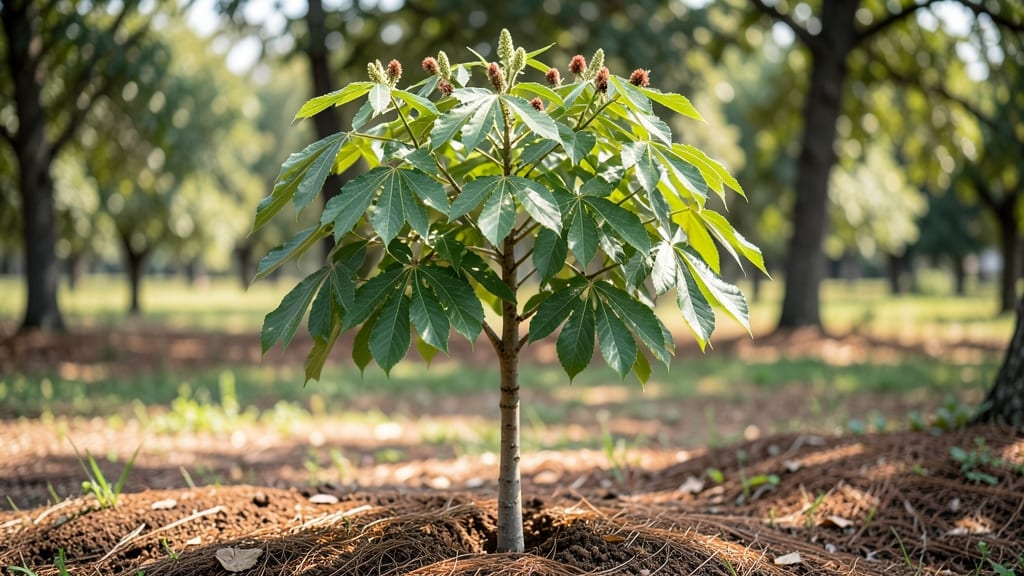
A young walnut tree looks like it has feathery, compound leaves with 5-9 sharp-edged leaflets that are dark green and slightly fuzzy, along with smooth gray bark that eventually develops distinctive diamond-shaped cracks. Its early growth is upright but slow, featuring small clusters of pale yellow-green flowers in spring before nuts appear in late summer.
A young walnut tree's most striking feature is its compound leaves, which resemble a row of tiny, jagged fingers stretching from a central stem. 🌿 These leaflets are usually 5-9 per leaf, with serrated edges that catch light differently than smoother oak or maple leaves.
The bark starts out sleek and gray but develops those signature diamond patterns as the tree ages—something that sets it apart from other nut trees.
What's fascinating is how the tree's growth mirrors its maturity: those first few years are all about building a sturdy frame before it starts producing nuts, usually around age 5-7.
If you're trying to spot one in the wild, look for those springtime flower clusters—they're small but noticeable, and they appear before the leaves fully unfurl. The flowers may not be showy, but they're a dead giveaway when you know what to look for.
And here's a pro tip: young walnut trees often grow in clusters, so if you see multiple saplings with similar leaf patterns, you might be looking at a walnut grove in the making.
💡 In This Article
- Identifying Walnut Tree Leaves and Bark at Early Stages
- Growth Habits and Seasonal Changes in Young Walnut Trees
Identifying walnut tree leaves and bark at early stages
The compound leaves of a young walnut tree are its most distinctive feature, with each leaf composed of 5-9 individual leaflets arranged alternately along a central stem.
These leaflets are typically 2-4 inches long, with pointed tips and sharply serrated edges that create a jagged silhouette when viewed from above.
The upper surface is a rich, dark green, while the underside often appears slightly lighter with a fine, downy texture that gives them a soft, fuzzy feel when touched.
What sets walnut leaves apart from similar trees like hickory or butternut is their arrangement and shape. Unlike hickory's 7-9 leaflets that often have a more rounded appearance, walnut leaflets are more elongated and taper to a fine point.
The bark of a young walnut tree starts smooth and gray, but even in its earliest stages, you might notice subtle vertical grooves forming. As the tree matures, these grooves deepen into the iconic diamond-shaped patterns that become more pronounced with age.
This bark evolution is a key identifier—black walnut bark develops these patterns earlier than English walnut, which tends to stay smoother longer.
The texture of walnut leaves also plays a role in identification. When you run your fingers along the underside, you'll feel that fine fuzziness, which is actually a layer of tiny hairs that help protect the leaves from pests and excessive moisture.
This trait is less pronounced in butternut trees, whose leaves tend to feel smoother. The leaflets also have a slightly leathery quality when mature, which helps them withstand the weight of snow or heavy rain without tearing easily. 🌿
One of the most reliable ways to distinguish a young walnut tree from others is by examining the leaflet attachment. Walnut leaflets are attached to the central stem by a short stalk, creating a distinct gap between each leaflet.
This "pinnate" arrangement is different from the "palmate" pattern seen in butternut trees, where leaflets radiate from a single central point. The gaps between leaflets also create a more "feathery" appearance when viewed from a distance, making walnut trees easier to spot in dense woodlands.
Bark texture is another critical clue. Young walnut bark is often described as "smooth but not silky"—it has a slightly rough, granular feel that becomes more pronounced as the tree ages.
This texture is a result of the tree's slow growth rate in its early years, which allows the bark to develop a more structured pattern over time. In contrast, faster-growing trees like maple or birch tend to have smoother, more uniform bark that lacks these distinctive grooves.
For those trying to identify a walnut tree in its first few years, pay attention to these three key traits: the 5-9 leaflets with serrated edges, the downy underside of the leaves, and the gradual development of diamond-shaped bark patterns.
These features, combined with the tree's upright growth habit, create a profile that's unique among North American hardwoods. 🌳