
Plants
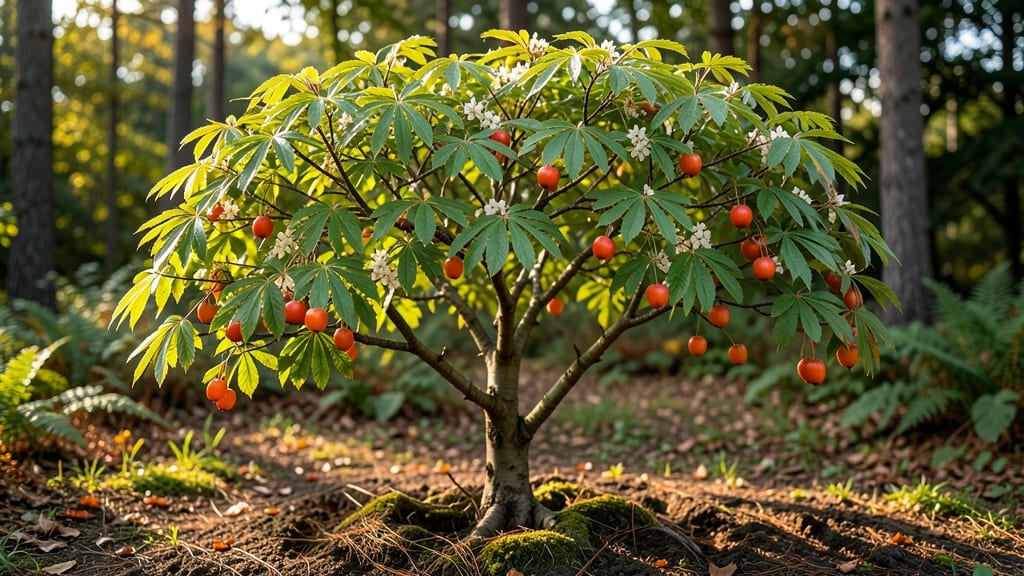
A rowan tree looks like a small, ornamental deciduous tree with a rounded crown, featuring bright red berries, lobed green leaves, and distinctive gray bark with horizontal lenticels. Its growth habit is upright yet graceful, reaching 15–30 feet tall with a slender trunk.
A rowan tree's most striking features are its bright red berries that persist through winter, creating a bold contrast against bare branches. 🌿 These berries are actually small pomes, clustered in tight groups, and are a key identifier when other trees have shed their foliage.
The lobed leaves resemble those of a maple but are smaller and more delicate, with serrated edges that give them a distinctive sawtooth appearance.
What really sets rowan trees apart is their scaly gray bark, which develops horizontal lenticels as the tree matures—these tiny raised lines create a textured pattern that's unique to rowan species.
These trees grow in an upright yet airy form, with branches that spread gracefully rather than densely. In spring, the new growth emerges with a faint red tint before turning deep green, while fall foliage often displays brilliant yellow or orange hues before the berries take center stage.
The combination of these visual elements makes rowan trees instantly recognizable in landscapes, especially when planted as specimen trees or in small groves.
💡 In This Article
- Identifying Rowan Tree Features: Leaves, Bark, and Branches
- Rowan Tree Growth Habit and Best Planting Conditions
Identifying rowan tree features: leaves, bark, and branches
The rowan tree's leaves are its first clue for identification, featuring 5-7 lobes with serrated edges that create a delicate, almost fern-like appearance. Each leaf typically measures 2-4 inches wide, with the lobes pointing outward like fingers on a hand.
These leaves emerge in spring with a soft downy texture that disappears as they mature into a glossy green. 🌿 What makes them unique is their ability to turn brilliant yellow or orange in fall, often while still bearing clusters of red berries—a stunning contrast that's hard to find in other trees.
The bark is another defining feature, starting smooth and silvery-gray when young but developing horizontal lenticels as the tree ages. These lenticels appear as raised, wavy lines that run parallel to the trunk, creating a textured pattern that resembles a fish scale.
Unlike the rougher bark of oaks or the peeling bark of birches, rowan bark remains relatively smooth but develops a subtle roughness with age.
In winter, when the tree is bare, these lenticels create a distinctive silhouette that helps distinguish rowan from similar trees like mountain ash, which has smoother, less textured bark.
The branches grow in a graceful, upright pattern with a slightly weeping habit, creating an open, airy crown that lets light filter through. Young branches often have a reddish tint that fades to brown as they mature, while the twigs themselves are slender with small buds that appear in clusters.
What's fascinating is how these branches spread outward at 45-degree angles from the trunk, creating a natural, balanced shape that's both elegant and sturdy. This growth pattern makes rowan trees excellent choices for small gardens or as focal points in landscape design.
When comparing rowan to similar trees, the berry clusters are the most reliable identifier. Rowan berries grow in tight, spherical clusters of 10-20 fruits, each about ½ inch in diameter, while mountain ash berries are more loosely arranged and often red or orange.
The rowan's berries also persist through winter, providing food for birds long after other trees have shed theirs. This persistence is a key adaptation—birds like thrushes and waxwings rely on these berries as a winter food source, helping disperse the tree's seeds.
The rowan's seasonal transformations are equally distinctive. In spring, the new leaves emerge with a faint reddish hue, creating a soft contrast against the gray bark. By summer, the foliage becomes dense and vibrant, while the berries ripen from green to bright red.
In fall, the leaves change color while the berries remain, creating a two-tone effect that's visually striking. Even in winter, the berries provide color against the bare branches, making rowan trees a year-round ornamental feature. 🌟
For those new to tree identification, start by looking for these three key features: the lobed, serrated leaves, the scaly gray bark with lenticels, and the dense clusters of red berries.
These characteristics work together like a natural fingerprint, making rowan trees instantly recognizable once you know what to look for. The combination of these features sets rowan apart from its closest lookalikes, like mountain ash or hawthorn, which lack this specific combination of traits.