
Diseases
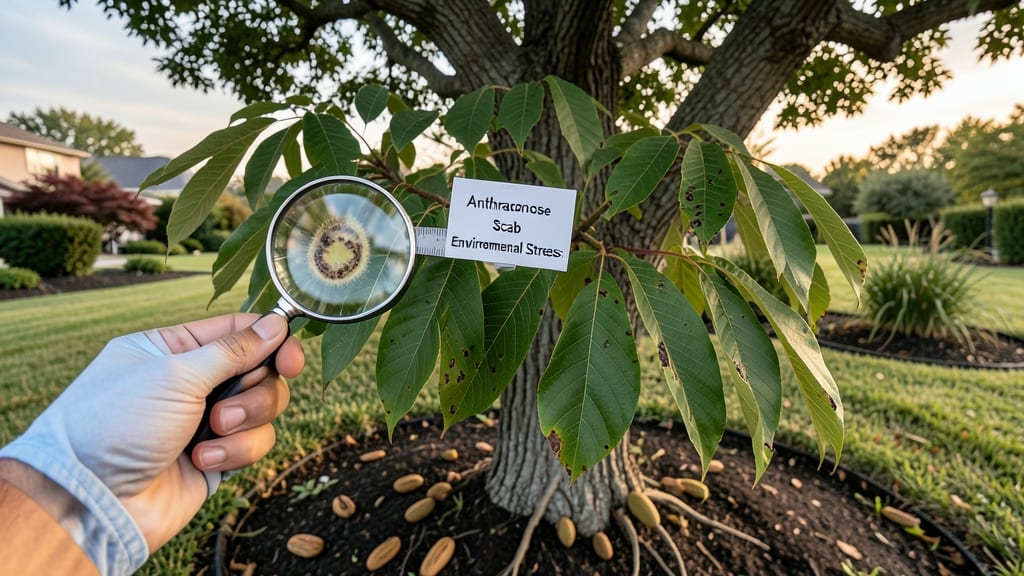
Black spots appearing on pecan tree leaves usually indicate fungal diseases such as anthracnose or scab, environmental stress, or pest-related damage. Quickly determine the root cause—whether it’s prolonged moisture, poor airflow, or aphid activity—then address it with targeted fungicide applications, strategic pruning, or adjusted irrigation practices to revive your tree’s health.
Those dark blemishes on your pecan tree’s leaves aren’t just cosmetic—they’re often a red flag for fungal infections that thrive in damp conditions. 🌱 For example, anthracnose spreads rapidly when leaves stay wet for more than 12 hours, while scab diseases create raised, crusty spots that can distort new growth.
I’ve seen cases where homeowners mistook environmental stress (like sudden drought) for fungal issues, only to realize the problem was actually poor soil drainage. The key is acting fast—once spores take hold, they can reduce your tree’s ability to photosynthesize efficiently, impacting next year’s nut production.
Don’t wait until the spots spread—start with a simple fungicide spray containing copper or potassium bicarbonate, and thin out dense branches to improve airflow.
For stubborn cases, I recommend a two-step approach: treat the foliage in the morning when humidity is lower, then follow up with a soil amendment like composted manure to strengthen the tree’s natural defenses. The sooner you intervene, the better your pecan tree’s chances of bouncing back.
💡 In This Article
- Identifying Common Fungal Diseases Causing Pecan Leaf Spots
- Step-by-Step Treatment and Prevention for Pecan Leaf Spot Diseases
Identifying common fungal diseases causing pecan leaf spots
Fungal pathogens like anthracnose (Colletotrichum gloeosporioides) and scab (Elsinoë spp.) thrive in pecan trees by exploiting weak spots in leaf tissue. Anthracnose creates sunken, dark brown spots with yellow halos, often appearing on younger leaves first.
These fungi release spores that germinate when leaf surfaces stay wet for 12+ hours, which is why spring showers or overhead irrigation create perfect conditions for outbreaks. The spores penetrate through natural openings like stomata or wounds, then multiply rapidly in the leaf's mesophyll layer, disrupting photosynthesis.
Scab diseases, on the other hand, produce raised, crusty lesions that feel rough to the touch, often with a white or grayish center. Unlike anthracnose, scab fungi (Elsinoë spp.) prefer moderate temperatures (75-85°F) and high humidity (80%+), making late spring to early summer the peak infection window.
These pathogens also release spores that stick to leaf surfaces via sticky conidia, creating a "glue-like" effect that helps them spread via splashing water or wind. The key difference?
Anthracnose spots are typically 1/4-1/2 inch wide with irregular edges, while scab lesions are more uniform and often covered in a powdery fungal growth.
Moisture isn't the only trigger—poor air circulation around dense foliage accelerates spore spread by keeping humidity trapped near leaves. I've seen cases where pecan trees planted too closely together developed severe leaf spot diseases because the canopy blocked airflow, creating microclimates with 90%+ humidity for extended periods.
Even well-drained soil can't prevent fungal spread if the tree's environment remains consistently damp. The lifecycle of these fungi is relentless: spores overwinter in infected leaves or bark, then launch new infections when conditions become favorable.
Diagnosing the specific fungus involves examining the leaf undersides for fungal structures. Anthracnose often shows pinkish spore masses in infected spots, while scab may reveal black fruiting bodies (acervuli) under magnification.
For homeowners, a simple field test is to place a suspect leaf in a sealed bag with a damp paper towel—if white fungal growth appears within 3-5 days, you're likely dealing with a pathogenic fungus. This quick test helps determine whether chemical treatments or cultural changes are needed.
Temperature plays a surprising role too. While most fungi prefer warmth, some pecan leaf spot pathogens (e.g., Cercospora spp.) thrive in cooler (60-70°F) conditions, explaining why late-season infections sometimes appear after summer heat breaks.
The science here is about spore germination thresholds: each pathogen has an optimal temperature range where its enzymes activate to penetrate leaf tissue.
For example, anthracnose spores germinate best at 77°F, while scab prefers 82°F—this explains why you might see different diseases dominating at different times of year.
What most people overlook is how leaf age affects susceptibility. Younger leaves (1-2 weeks old) are particularly vulnerable because their cuticles haven't fully hardened, making them easier targets for fungal penetration.
Mature leaves develop thicker wax layers that repel spores, which is why you'll often see new growth showing the first signs of infection. This biological quirk means timing your fungicide applications to coincide with leaf flush periods is critical for prevention.