
Plants
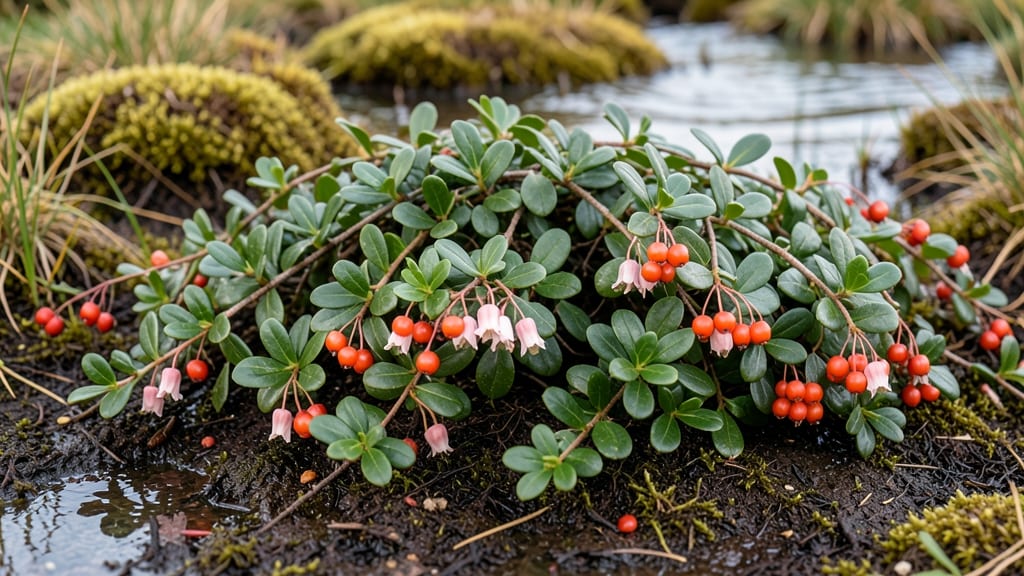
A cranberry tree looks like a compact evergreen shrub with glossy dark green leaves and clusters of white spring flowers. Its berries grow in drooping bunches, ripening to deep red, though true cranberries are actually low vines—not trees—with similar foliage. Cultivated varieties like bog cranberries can grow 3–6 feet tall with woody stems.
A cranberry tree's appearance can be confusing because most people picture the low-growing vines of wild cranberries. 🌿 The "trees" you see in gardens are actually specially bred shrubs like Viburnum trilobum, which produce berries similar in color but not the same species.
These shrubs have oval leaves with toothed edges and develop a smooth gray bark as they mature. The real giveaway is the berry clusters—pendulous and bright red when ripe, often used in ornamental landscaping.
One key difference from true cranberries is the leaf arrangement: these shrubs have opposite leaves (paired at each node) while cranberry vines have alternate leaves. In fall, the foliage turns shades of yellow and orange, adding seasonal interest.
If you're comparing to blueberries, note that cranberry shrubs have larger, more rounded leaves and berries that stay firm even when overripe.
💡 In This Article
- Identifying Cranberry Plant vs. Tree: Key Botanical Differences
- Visual Guide to Cranberry Leaves, Berries, and Bark
Identifying cranberry plant vs. tree: key botanical differences
The confusion begins with the name itself—what we call a "cranberry tree" is rarely a true tree. 🌱 True cranberries (Vaccinium macrocarpon) are low-growing, creeping vines that spread horizontally across acidic bogs, rarely exceeding 12 inches in height.
Their stems root at nodes, creating dense mats. The "trees" you see in nurseries are actually shrubs from the Viburnum genus, like Viburnum trilobum (highbush cranberry), which can grow 6-12 feet tall with upright stems.
Leaf structure is the first clue to tell them apart. Cranberry vines have alternate leaves—each leaf grows singly at a node along the stem—while Viburnum shrubs feature opposite leaves, appearing in pairs directly across from each other.
The leaves themselves are similar in shape (elliptical, 2-4 inches long), but Viburnum leaves have 3 distinct veins from the base, while cranberry leaves typically have 1 central vein with secondary veins branching outward.
Bark texture reveals another difference. True cranberry vines develop a reddish-brown, fibrous bark that peels in strips, while Viburnum shrubs have smooth, gray-brown bark that develops shallow furrows as they age. This distinction becomes more visible in winter when leaves fall, leaving the bark as the primary identifier.
The berries also differ: cranberries grow in pendulous clusters (hanging downward), while Viburnum berries remain upright on the stems.
Even among cultivated cranberries, the confusion persists. Varieties like 'Ben Lear' or 'Stevens' are bred to grow slightly taller (2-3 feet) with woody stems, but they still spread horizontally like vines. These are often marketed as "upright cranberries" to save space in gardens.
The key is their trailing growth habit—no matter how tall they grow, they'll always send out runners that root into the soil, creating a vine-like structure.
What most people don't realize is that the berries you find in grocery stores (true cranberries) and the ornamental berries on Viburnum shrubs aren't even closely related. True cranberries have a waxy, translucent skin that makes them buoyant in water, while Viburnum berries are firmer and lack this characteristic.
The taste also differs: cranberries are tart and astringent, while Viburnum berries are milder and sweeter, often used for jellies rather than sauces.
For gardeners, this distinction matters when choosing plants. True cranberries thrive in bog-like conditions (constant moisture, acidic soil), while Viburnum shrubs adapt to drier, well-drained soils.
The ornamental varieties are prized for their fall foliage colors (reds, oranges) and winter interest, whereas true cranberries disappear underground in winter, leaving only their buds visible.