
Blooming
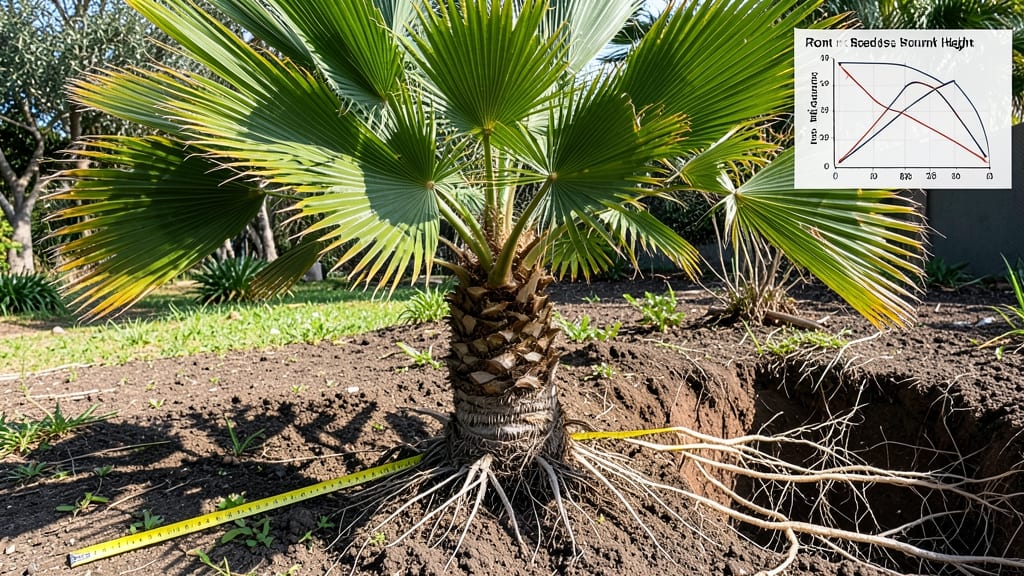
Palm tree roots typically spread 1.5 to 3 times the tree’s height horizontally and extend 3 to 6 feet deep, though some species like the coconut palm can reach 15 feet downward. Shallow, fibrous surface roots dominate in most palms, competing for nutrients and space in the soil.
Understanding how long palm tree roots grow helps you plan for their space needs.
Most palms develop extensive lateral roots that spread outward, creating a wide but shallow network just below the soil surface. 🌱 This horizontal growth pattern explains why palms often outcompete nearby plants for water and nutrients, especially in sandy or nutrient-poor soils.
The deeper roots you see in species like the coconut palm are exceptions—they adapt to stabilize the tree in windy coastal areas, where surface roots alone wouldn't provide enough anchorage.
For gardeners, this means planting at least 3–5 feet away from structures to avoid root damage to foundations or pipes. The shallow nature of most palm roots also makes them vulnerable to soil compaction—something to watch for when installing irrigation systems or laying down pavers.
If you're dealing with clay-heavy soil, consider amending it with organic matter to encourage healthier root development.
💡 In This Article
- Palm Tree Root Systems: Depth, Spread, and Species Variations
- Planting Palm Trees: Soil Preparation and Root Space Requirements
Palm tree root systems: depth, spread, and species variations
The shallow, fibrous root systems of most palm trees are a direct adaptation to their tropical environments. Unlike deciduous trees with deep taproots, palms develop a dense network of lateral roots that spread horizontally within the top 6 inches to 2 feet of soil.
This structure maximizes water and nutrient absorption in nutrient-poor, sandy soils where deep roots would struggle. 🌿 For example, a 20-foot-tall Mexican fan palm might have roots extending 30–60 feet outward but rarely deeper than 3 feet, creating a vast but shallow "root mat" that stabilizes the tree against wind.
Species like the coconut palm break this rule with their specialized adaptations. Their roots can extend 15 feet deep to anchor the tree in storm-prone coastal areas, while still maintaining a wide lateral spread.
The key difference lies in their pneumatophores—specialized aerial roots that absorb oxygen in waterlogged soils, a feature absent in most palms. Even here, the primary root mass remains within 6–12 feet deep, with only a few structural roots penetrating further to reach groundwater.
Soil conditions dramatically influence root depth. In compacted or rocky soils, palm roots may grow 20–30% deeper in search of water, while loose, well-draining soils encourage the shallow spread.
Drought stress triggers a fascinating response: roots produce ethylene gas, which signals the tree to send out more lateral roots near the surface rather than growing deeper—a survival mechanism to intercept rainwater quickly. This explains why palms often thrive in areas with seasonal droughts despite their shallow roots.
One surprising fact is how root spread correlates with canopy size. A 10-foot-tall palm might have roots extending 15–20 feet outward, while a 50-foot royal palm could spread 75–100 feet—a ratio that maintains stability as the tree grows taller.
This horizontal dominance is why palms often uproot sidewalks or damage underground infrastructure when planted too close to structures. The root-to-canopy ratio remains remarkably consistent across species, with most palms maintaining a 1.5:1 to 2:1 spread-to-height ratio.
For gardeners, this means planning for at least 3–5 feet of clearance from buildings or hardscapes. The shallow root zone also explains why palms are vulnerable to soil disturbance—digging near the trunk can sever critical lateral roots, leading to stress or even death.
Understanding these patterns helps you choose palm species suited to your soil type and space constraints, whether you're planting a dwarf palm for containers or a tall coconut palm near the beach.
What most people overlook is how root growth changes with age. Young palms focus on lateral spread to establish themselves, while mature trees develop slightly deeper roots for stability.
This shift explains why older palms often have more pronounced root damage to nearby structures—a gradual process that becomes critical in urban landscapes. 🌊