
Orchid Care
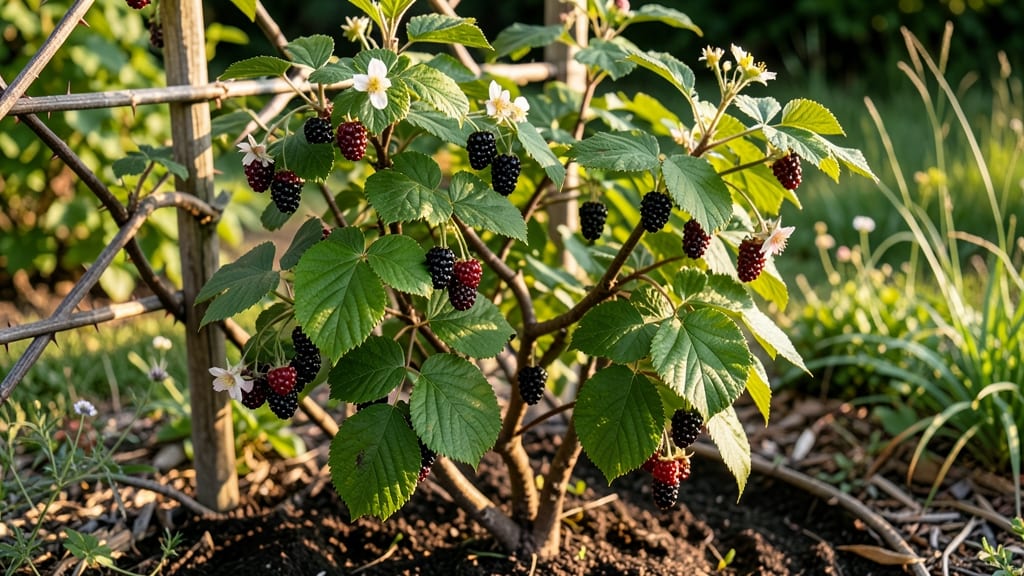
Boysenberries grow as vigorous bushes (not trees), reaching 6–10 feet tall with thorny canes that demand sturdy support and 4–6 feet between plants for airflow and fruit quality. Compact varieties under 3 feet work well in containers or tight spaces.
These berries thrive as deciduous shrubs, not trees, with arching canes that sprawl aggressively if unchecked.
The thorns aren't just for defense—they protect tender fruit from birds and pests while encouraging vertical growth on trellises. 🌿 What's fascinating is how their growth habit changes with pruning: regular thinning in late winter promotes larger, more productive canes for the next harvest season.
For gardeners with limited space, dwarf varieties like 'Black Diamond' or 'Thornless Boysenberry' offer the same sweet-tart flavor without the sprawl. These compact types grow just 2–3 feet tall, making them perfect for patio containers or small urban yards.
Just remember: even dwarf varieties need at least 3 feet of width to avoid overcrowding, which leads to disease.
💡 In This Article
- Boysenberry Bush Growth Habits Explained
- Best Space-Saving Boysenberry Varieties for Small Gardens
Boysenberry bush growth habits explained
Boysenberries aren't trees—they're deciduous shrubs with a complex growth structure. Their canes grow from a deep, fibrous root system that spreads horizontally, sending up multiple arching stems each year. These canes are semi-woody, with the current year's growth (primordial canes) producing fruit while older canes gradually die back.
The confusion with "tree" likely stems from their height—some varieties reach 10 feet—but their branching pattern and lack of a single trunk distinguish them clearly as shrubs.
The thorns aren't random—they're strategic. Each cane develops 1-2 inch long thorns along its length, especially near fruit clusters, creating a natural barrier against birds and rodents. These thorns also encourage vertical growth when trained on trellises, as the plant naturally climbs for better sunlight exposure.
The density varies by variety, with 'Thornless Boysenberry' having minimal prickles but still requiring support for fruit-bearing canes.
Seasonal growth follows a precise rhythm: canes emerge from dormancy in early spring, growing rapidly until summer when they flower. Fruit develops on current-season canes, while next year's growth begins at the base.
Pruning in late winter removes old canes (over 3 years old) and opens the center for airflow—critical for preventing fungal diseases like botrytis. Without proper pruning, canes become overcrowded, leading to smaller berries and increased pest pressure.
Here's what's actually happening underground: boysenberries develop a suckering habit, sending up new shoots from the root crown. While this expands the plant's footprint, it also creates competition for nutrients.
The root system extends 2-3 feet deep but spreads even wider horizontally, which is why spacing matters. In tight spaces, this aggressive root growth can become problematic, crowding out nearby plants.
Trellising transforms growth patterns completely. When canes are trained vertically, they produce 20-30% more fruit than when left to sprawl, thanks to improved sunlight exposure and airflow. The ideal trellis height should be 6-8 feet to accommodate mature canes.
Without support, canes flop to the ground, creating moist conditions that invite mold and reducing fruit quality.
Consider these key factors when planning your bush:
- Canes per plant: A healthy bush produces 10-15 canes annually, with only the current and previous year's growth bearing fruit
- Fruit production zones: Berries develop on wood from the current growing season, not on old wood
- Pruning window: Late winter (before buds swell) is ideal for removing 2/3 of old canes while keeping 3-5 strongest new canes
- Thorn density: 'Black Diamond' has moderate thorns while 'Thornless' varieties reduce handling difficulty by 70%
The science behind their vigorous growth lies in their hybrid nature—boysenberries are crosses between blackberries, raspberries, and loganberries, inheriting the rapid growth habits of all three.
This hybrid vigor explains why they outperform many other berries in yield, but it also means they demand more space and maintenance to reach their full potential. 🌱