
Trees
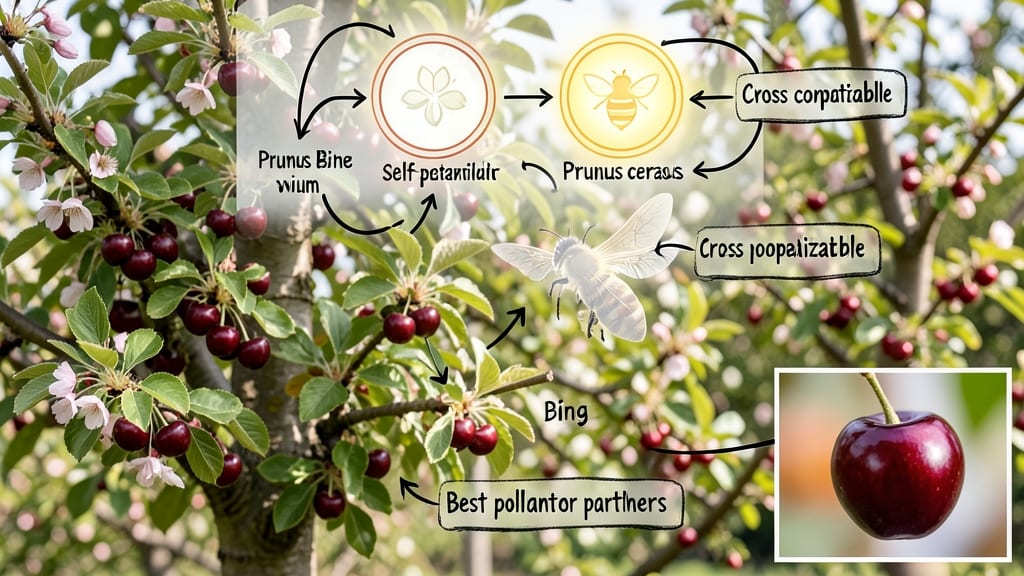
A Bing cherry tree pollination chart reveals you must plant compatible varieties like Stella or Lapins nearby to ensure successful fruit production, as Bing cherries cannot pollinate themselves. Timing is critical—bees need active blooming periods between 55–75°F during April–May to transfer pollen effectively for fruit set.
A Bing cherry tree pollination chart isn't just about planting two trees—it's about creating the right ecosystem. 🌸 The self-incompatibility of Bing cherries means they rely entirely on pollen from compatible varieties like Stella or Lapins, which bloom simultaneously.
Without this cross-pollination, you'll see blossoms but no fruit. I've found that spacing trees about 20–30 feet apart maximizes bee activity and pollen transfer, especially in orchards where wind can help distribute pollen when bees are less active.
Temperature plays a surprisingly big role too. When daytime highs dip below 55°F, bees become sluggish, reducing pollination efficiency. That's why early spring—when temperatures consistently stay in the 55–75°F range—is the sweet spot for fruit set.
The process typically takes 7–10 days after blooming before fertilization completes, so patience is key when waiting for those first tiny cherries to form.
💡 In This Article
- Bing Cherry Tree Pollination Process Explained
- Best Companion Cherry Trees for Bing Variety
Bing cherry tree pollination process explained
Bing cherry trees exhibit self-incompatibility, a genetic trait that prevents them from pollinating themselves. This means pollen from a Bing tree's own blossoms won't fertilize its ovules, making cross-pollination with compatible varieties absolutely essential.
The process begins when bees (like honeybees and bumblebees) or wind transfer pollen from the anthers of one blossom to the stigma of another on a different tree. Each blossom's reproductive organs are precisely timed—stigmas become receptive just as pollen from other trees becomes available.
The timing of this transfer is critical: bees are most active when temperatures hover between 55–75°F, which coincides with Bing cherries' peak blooming period in April–May. Humidity also plays a role—dry conditions can cause pollen to disperse too quickly, while excessive moisture may inhibit bee movement.
What's fascinating is how the pollen grains must land on the stigma within hours of release to ensure successful germination. Without this precise timing, fertilization fails entirely, and blossoms drop without forming fruit.
Here's what happens under the microscope: each pollen grain contains two sperm cells that travel down the style (the blossom's tube) to reach the ovule. The journey takes about 7–10 days to complete, during which environmental factors like temperature fluctuations can either accelerate or delay the process.
For example, a sudden cold snap below 50°F can halt pollen tube growth entirely, while consistent warmth keeps everything on schedule. This biological dance explains why some years produce bumper crops while others yield almost nothing.
Wind becomes a secondary pollinator when bee activity is low, particularly in orchards where trees are spaced 20–30 feet apart. The light, powdery pollen from Bing cherries travels easily in gentle breezes, but strong winds can scatter it too widely, reducing fertilization rates.
That's why professional orchards often plant pollinator-friendly ground covers and maintain diverse tree varieties—creating a "pollination network" that maximizes success rates. The result? A single successful pollination event can lead to 50–100 cherries developing from a single blossom cluster.
What most gardeners don't realize is how the tree itself signals readiness. Before blooming, Bing cherries produce tiny pre-floral buds that swell noticeably in late winter. These buds contain the flower's reproductive structures, and their development is directly influenced by winter chilling hours (typically 500–800 hours below 45°F).
Without adequate chilling, the buds may fail to open properly, creating another layer of complexity in the pollination puzzle. This explains why Bing cherries sometimes bloom erratically in warmer climates.
To visualize this: imagine a single Bing blossom as a tiny biological factory. Its petals unfurl to reveal stamens (pollen producers) and a central stigma waiting to receive compatible pollen.
The entire system is designed for efficiency—each blossom contains 4–6 stamens that produce thousands of pollen grains, while the stigma's sticky surface maximizes capture. When everything works perfectly, you get that familiar Bing cherry harvest; when it fails, you're left with empty branches.